Stop Tolerating Pain From Your Partner


Maintaining emotional intimacy means accepting your partner for who he or she is. But some behaviors you should not be tolerated even if it means creating distance. How do you know if you are accepting your partner or simply tolerating behaviors that are harmful?

Acceptance feels like giving a gift while tolerating feels forced. Acceptance comes from your heart and is an expression of love for your partner. When you are tolerating behaviors you are failing to address your discomfort. You are telling yourself that this is a price for being in the relationship. But is it a price you should be paying?

Acceptance is a position of strength. You are mature enough to recognize that you and your partner have different views, reactions and goals. You accept the differences out of respect and caring for your partner. You expect the same in return; acceptance is shared.

Tolerating a behavior is more one-sided. You are being asked to absorb the pain but you are not hurting your partner in exchange. Behavior that is tolerated never loses its ability to cause you pain. The price you pay for tolerating the behavior continues to be the same (or greater) in the weeks, months and years to come.

If you find that you are tolerating behaviors that are harmful, you must address this with your partner in a manner that does not sound like criticism. You want to trigger your partner to hear your pain, not become defensive. This may require you to rehearse what you want to say and to be willing to repeat the message until it is heard.

If your partner remains defensive or uncaring to your message then he or she should get less of you. Distancing physically, emotionally and sexually sends the message that the relationship does not feel safe. This can be done gradually, but must be a consistent message. The surprising result can be that your partner may reassesses your worth and be more than willing to work on improving your connection.


Keeping the Team Together


Most sports teams now spend time examining film from their previous game. The goal is to identify ways the team can improve its play in the next game. The danger is that the team can start to parcel out blame for their poor performance. This then can tear the team apart which can lead to more poor play.

The coach's job is to keep the players focus on the future, how they can play better, not who is responsible for losing the last game. So, what does this have to do with marriage? As a marriage counselor, my job is to keep the couple focused on improving their interaction, not parceling out blame for their relationship problems.

When you dish out blame, you inevitably trigger a defensive response. Your partner doesn't want to be held accountable for your pain and doesn't want to be labeled as a bad person. Yet the defensive stance leaves you feeling unheard and that your partner doesn't care about your views and feelings. So you turn up the heat and become more aggressive in delivering your message. This aggression then triggers distance, the team comes apart.

Successful couples are able to focus on what it will take to have a better relationship in the future. They address their feelings but ask for improvement. They do not shame. Shame triggers a defensive response; a request for improvement asks for accountability. Be accountable for your part in our relationship, while I accept my part.

Just as the sports team must focus on specific ways they can play the game better the next time, you must address specific measures you can take to improve your relationship. The team can't say, "We need to play better the next time." The couple can't say, "We need to communicate better." Both are too general. What specifically needs to change to improve your communication?

Imagine you are seeing your improved relationship played on a television screen. What would you see? How are you behaving toward each other? What is your contribution to this? Notice the details, these are the things you can change which will ultimately lead you to win the relationship game.


It Really Isn't About The Nail, Connecting Emotionally When A Solution Seems Better


I have become a little obsessed with this video. In fact, I could say that it is one of my favorite films even though it only lasts only a little over a minute and a half. The message is layered and the acting is superb. The filmmaker really hits on a topic that confronts every couple, but uses humor to get the message across. And isn't humor best when you can relate?

The woman begins by addressing her pain, particularly the pain of not knowing when the pain will end. The man responds by pointing out the obvious, she has a nail in her forehead, yes a real nail in her forehead. It seems simple enough, let's get the nail out.

This seems logical enough, yet the woman says "It's not about the nail." How can it not be about the nail, when the solution is right there in front of us (literally). The answer is that it is not about the nail, but the pain she is experiencing. She is searching for empathy, not a solution to the problem.

The man persists in his rebuttal that the pain will go away if the nail is removed, but he misses the mark and is reminded that it is about her pain not the cause of the pain. Then he shifts and sees the problem through her eyes and reassures her that "it must be hard." She immediately shifts into an affectionate tone, touches his hand and lets him know she is feeling soothed.

Men naturally (as in how their brains are programmed) want to remove pain from their partner, particularly if they have caused the pain. Men do not like to listen to pain - in that way, they tend to be more sensitive than women. Men move beyond pain for survival while women respond to pain with a desire to nurture for survival (again, their brains are built to nurture children).

Never the less, the way you respond to your partner is behavior that can be shaped. The film shows that behavior can change. In this case, the woman seeks to be nurtured and finally receives it. The man fails to negotiate her to understand how difficult it is to see that nail sticking out just ready to be pulled out of her forehead.

Couples can have it both ways. Men can be more nurturing to the woman's pain while women can be more understanding of the man's desire to remove pain (and a variety of unpleasant feelings) through problem-solving. Too often men and women insist that the relationship will be better if it is done their way, when the truth is that the relationship will be better if you are sensitive to your partner's way, even if it seems like you only have to get the nail out.


Five Skills For Surviving a Rough Patch


Commitment to a relationship isn't expressed when things are fun and the going is easy. Commitment is expressed when you awaken to a more distant relationship that causes pain. You question whether you will ever regain the connection you once felt and feel helpless to make it happen. 

Here are some suggestions for finding your way through the rough patches in your relationship.

Expect the path to become rough. 

Don't allow yourself you become shocked and emotionally overwhelmed when you see distance forming in the relationship. Couples should expect issues to occur in their relationship that cause distance. You do not share the same experiences, outlooks and expectations. These differences can be difficult to negotiate.

Insecurity can cause one to question whether distance is a sign pointing to the end of the relationship. Insecurity can be expressed vulnerably or can lead to criticism and blame.. Secure couples don't overreact to this distance. Instead, they focus on healing the divide. Emotions are held in check through focusing on the issue rather than the distance that has occurred. 

See the need for change. 

Just as sports teams must make adjustments to their game plans, couples must learn to see tensions as signals for change. Insecure couples see tension as something to be avoided while secure couples accept tension as signalling dissatisfaction in one or both partners. A rough path can lead to higher ground. 

Feelings are expressed for connection, not blame. 

Secure couples open up more when there is tension. They own their emotions and express a desire to be heard. Their partner listens with empathy but also provides encouragement that change is possible. 

Insecure couples express feelings as criticism and this triggers a defensive response. Defensiveness shuts down communication, causing more distance. Secure couples accept tension and pain as a natural byproduct of distance from their partner. They work to address these feelings and often heal the distance simply by connecting emotionally.

Balance tension with recreation. 

Tension can weigh you down. Often rough patches in a relationship develop over time and can only be resolved over time. The tension in the relationship must be balanced with an effort to lighten up through mutually enjoyable activities. Agreeing to enjoy a night out or to find an enjoyable show to watch on TV can help to manage the tension.

Affirm your commitment to the relationship. 

When tensions form, insecurity can be triggered. You may question you partner's commitment; does he/she really care about you? Secure couples can ask for reassurance of their partner's commitment to the relationship and can offer their own commitment to moving forward in the relationship.


Are You Protecting Yourself or the Relationship?


When you feel attacked, it is natural to assume a defensive stance. You want to say, "Hey wait a minute, I'm a good person and you are making me feel as though I have done something really awful." A typical defensive stance is to try to explain your motivation ("I was just trying to ...") or to minimize the impact your behavior should have had ("You are looking at this all wrong").

Take Responsibility 
When you feel attacked you may justify your response based on this as a trigger ("She made me do it"). Yet, when you send your children to school, you expect them to take responsibility for their behavior and not blame other children for getting them into trouble. Take responsibility for your reaction regardless of how aggressive your partner has become in trying to get your attention.

It's Not All About You
When your partner triggers you to be defensive, an effective way to react is by asking the question, "What is he or she saying about him or herself?" Remember, when you feel attacked the message is all about you. Well the message isn't all about you. Your partner is trying to let you know what impact your behavior is having on him or her.

By responding to your partner's views and feelings, you will effectively take the wind out of your partner's sails. His or her emotions will settle down and the possibility of an exchange will be restored. Too often counselors will train couples to use listening without clarifying why listening is so important. Listening gets you out of your own protective barrier and lets you hear your partner's views and feelings...even if you disagree with the portrayal of you.

Listening
Your partner will make mistakes as he or she tries to address issues. One mistake is to criticize or attack you. This is a mistake because it does not ask you to care and instead makes you want to defend yourself. Don't take the bait! Instead of defending yourself, take the higher ground and reflect on your partner's message about him or herself.

Jenna is upset because Gene has procrastinated in taking out the garbage and she feels nauseated by the smell. She sees this as a pattern of procrastination and now is the time to let her feelings she has been holding in out. "Can't you take some responsibility around here? You just sit there oblivious to that stinking garbage. Maybe you think if you wait long enough, I'll do it. You can be so lazy and it really pisses me off."

Gene has been sitting enjoying the movie and this message really catches him off guard. Jenna is rarely so mad and certainly not typically aggressive over such small issues. He could simply ignore her message and say, "I'll get it." and finish watching the show. Or he could strike back, "Why do you have to be such a nag? I'll take care of it, just quit nagging me." Both of these responses are likely to create distance and more anger for each.

Instead, Gene can acknowledge her feelings and say, "I'm sorry, nobody likes the smell of garbage. I'll take it out now so you won't have to smell it." He may feel she has disregarded his feelings but he elects to address her feelings, then separately he can address her tone. Later he says, "I want you to be able to let me know when something is bothering you, but I want you to say it in a way that I can hear you. It is difficult to hear you when it feels like an attack." He is more likely to be heard because he showed Jenna that he cared about her message.

Couples that show they care for each other by listening for their partner's message become more satisfied with their relationship. Couples that fail to listen find that their relationships become more shallow and distant. Start today to build a connection based on a willingness to listen for your partner's message.


Rediscovering Passion


Passion is a reward, not a right. Do you complain about the lack of passion in your relationship as though you have nothing to do with its absence? Do you think that the passion you once had in your relationship would continue naturally? Do you let your partner know that you are disappointed in the lack of passion in your relationship by delivering complaints?

It is common for couples to lose passion in their relationship, but passion does not have to be gone from the relationship. Relationships can recover passion, but it takes effort to maintain that connection. Passion becomes the reward for a deeper connection, a connection that must be nurtured.

Passion requires teamwork. Passion is the byproduct of a couple's effort to connect on a deeper level. This means that each is contributing to the emotional, physical and sexual connection. Do you play together, discuss your personal struggles and flirt with each other? If you only connect through one channel, your connection will become less intense. Relationships need to be fed through multiple avenues - sharing feelings, mutually enjoyable activities, and sexual connection - all on a regular basis.

Passion can be a byproduct of conflict. Couples that avoid tension ignore differences to keep tension low. This limits each's voice in the relationship which, in turn, limits intimacy. When couples avoid tension, they invite a superficial connection. Such couples often describe their relationship as "living as roommates." Roommates are not passionate.

By confronting their differing views, feelings and desires, couples give voice to their deeper selves. Resolving these differences leads to feeling equal and accepted. Equality says, "You are valuable to me." Acceptance says, "I love you for yourself." These messages trigger passion.

Passion can be fleeting. Passion is a more uncommon expression than a common one. It is not something you should expect, but is a surprise, particularly when it arises between both of you at once. Typically, passion may be held more in one partner than in the other.

Passion can be actively avoided if it is only associated  with sex. Instead, passion must be expressed to in a flexible manner. Passion can be expressed through play, laughter, competition, as well as sex. 

Find many paths and expressions for passion in your relationship.

Forgiveness Is A Process


The process of forgiveness begins with a sincere apology for causing pain, but an apology is insufficient if the pain is great. Then you must be able to show you understand just how much your partner is hurt. If you fail to show sufficient empathy, then your partner will be tempted to dramatize the pain to get you to see how much hurt you have caused. Even worse, your partner may be tempted to cause you pain so that you can appreciate the pain you have caused.

Forgiveness requires the hurt partner to be willing to share pain in a vulnerable tone and to be willing to accept soothing for the pain. The process can be blocked indefinitely if one holds onto the pain. One reason to hold onto the pain is that it has traumatized you and it is difficult to absorb the reality of the action. But another reason to hold onto the pain is to avoid the risk of regaining the closeness you once had, then risking further pain. In this way, pain is a protection from further pain, but also a barrier for regaining emotional intimacy.

If you have hurt your partner, be strong enough to go down the path of understanding your partner's pain instead of defending your actions. If you have been hurt, be strong enough to share your pain, but allow your partner to be soothing so that you can be forgiving. Forgiveness is a process not a choice. Both of you must be patient enough to wait for the pain to recede and the desire for connection to emerge.

Five Steps to Making Couples Therapy Successful


Deciding to seek couples therapy is only the first step to creating a improved relationship. Now you must think about how you can make couples therapy successful. Here are five steps you can take to get off on the right foot.

1. What would a positive outcome look like? Imagine that therapy has helped transform your relationship. What changed? If someone close to you noticed the change, what would they see that would indicate your relationship is improved? If your relationship was filmed, what would you see on the screen that has changed?

These questions will get you thinking about your relationship in terms of behavior change. You can also think about how your feelings would change with the change in your relationship. 

2. What would be your contribution to the change you would like to see? You probably have a list of changes you partner could make to increase your satisfaction in the relationship. If you enter couples therapy with this agenda, your partner will feel blamed, become defensive and resist change. Instead, you should consider what you could contribute to an improved relationship, assuming your partner is also willing to make a similar contribution. 

3. How do you expect the therapist to conduct the session to be helpful to the relationship? You don't have to know what couples therapy is all about to imagine how a therapist could be helpful. Do you see your therapist as being more in control of the session or turning control over to the couple. Do you expect your therapist to give advice or be more of a listener? 

How will you judge whether your therapist is being effective for your goals? What personality would you prefer for your therapist to have? Do you want a highly structured therapy session or a more relaxed approach?

4. How much of a commitment to therapy are you willing to make before judging whether therapy is helpful? Some couples only give therapy one session to give hope for relationship change, while most realize that couples therapy is a process that must be assessed over several sessions. 

Discuss with your partner what your expectations are for the number of sessions and amount of time you will give couples therapy before deciding it is ineffective. By having this discussion, you will build accountability for a future moment when one of you loses motivation or feels discouraged by a lack of progress.

5. Consider potential stumbling blocks to maintaining your commitment to couples therapy. The dropout rate for couples therapy exceeds that of individual therapy. It is easy to see why. 
  • You have twice the struggle to free up with time for therapy. 
  • Loss of motivation in one partner undermines therapy for both. 
  • Quick improvement in the relationship can lead to ending treatment before long-lasting change has been made. 
  • Therapy can create tension that can lead one or both of you to avoid by simply ending therapy.

Now is the time to address issues that may arise so that you remain motivated to proceed with therapy rather than allowing there to be a premature exit. Assessing your expectations, motivation and potential stumbling blocks can increase the likelihood that couples therapy will help you to regain the connection you desire.

I Want to be Heard!


Marriage counselors hear one complaint far more than any other. "We don't communicate." While this can have many meanings, the couple typically agree that they have lost a connection they once had. They are not longer comfortable sharing their views, feelings and desires, Where they once shared their inner self, they describe only more superficial sharing. Where they once felt accepted for what they shared, they now fear judgement or sparking an argument. It is simply easier to avoid deeper conversations.

So what changed? Instead of sharing, conversations shift to making a point or asking your partner to change. When this occurs, it triggers the listener to go on the defensive. He or she stops listening and starts to formulate a counter statement. If your partner is defending him or herself, you are not being heard. Raising your voice doesn't help because volume isn't the problem.

The best way to be heard is to listen for your partner's message. If you are getting a message that he or she is becoming defensive, assume a stance of trying to understand what triggered this response. Often men hear criticism when the woman is trying to communicate a desire to be closer. The man only hears that he is falling short. Attempt to clarify that you are not placing blame but looking for improvement in the relationship.

If you assume a listening stance, you will often be amazed at what you can learn about the inaccurate message your partner has received, often over many years. Marriage counseling is often helpful simply by helping couples to clarify their messages through listening in a structured way. That structure is actually quite simple - clarifying what you hear rather than immediately responding to what you hear.

Try this exercise. One partner makes a statement they believe to be true about the relationship. The other partner then is to make statements such as "Do you mean...?" The objective is to receive three "yeses" before you reverse roles. Make this playful; avoid being aggressive. Take turns and notice how you find the conversation turning more intimate and warm.


As Your Life Becomes Larger, Is Your Marriage Becoming Smaller?


When you first fell in love, your relationship was the centerpiece of your life. It was your primary source of happiness and joy. While you devoted energy to other activities, you stored up energy to spend time with your new love. Finding mutual activities was not a problem, just spending time together was the primary goal.

As time progressed, the relationship solidified into a more secure, committed relationship in which each of you won the heart of your partner. Then your life expanded as your attention became divided  with your careers, hobbies/interests, new electronic devices, friendships, children and a seemingly endless to-do list.

Now the relationship is secure and can weather some neglect because you each remain firmly committed to the marriage. Your partner understands the need for longer work hours and then time to unwind in front of your electronic device. Your partner understands your focus on the children and the need you feel to supply them with an endless list of activities to enrich their lives.

But what happens to your relationship as you focus much of your energy in other directions? Much like a plant that is not watered and fertilized, the relationship does not die immediately but withers over time. What began as a close physical and emotional connection becomes a family factory. The factory produces excellent careers, outside connections and children who receive the best in enriching activities, but the factory lacks the warmth of connection.

Many couples wake up to a marriage in which they have taken their relationship for granted, only to find distance and dissatisfaction. Now is the time to either prevent that from happening to your relationship or to take your relationship back from everything that has kept you from maintaining the connection you once thought would last forever.

Early on it seemed easy to find time to be together, but now it is a challenge. You must make time for your relationship. You must make time on a daily basis for connection. Connection means taking time to talk in a manner that says, "You matter to me." Set up "mini dates" in which you center the activity on your relationship, even as you only have a few minutes and are confined to the home.


When Is A Marriage Hopeless?


When in the midst of a marital crisis, it is not unusual to question whether the marriage is hopeless. Can this relationship ever be as satisfying as it once was or is it doomed to be a constant source of tension and displeasure? Do you keep trying or do you throw in the towel?

Marital problems or a sign of what is to come? 
Your relationship hurts and you ask yourself if this pain is what you can expect in the years to come or is it possible to regain the love you once shared? How can you tell? Can you trust your partner's words that promise change, or is this a temporary bandage which will not remain stuck? Are you sure your heart is even available to your partner regardless of how the relationship changes?

These are difficult questions that are common when one begins to question their commitment to their marriage. These are questions that frequently have no definitive answer. They leave you sitting uncomfortably on the fence between ending the marriage and giving it another try.

Assessing your partners commitment.
Sometimes it is easy to tell that your partner is not committed to the relationship, but now your partner promises change and is inviting you to join him or her in creating a new, improved relationship. 

The problem is that you've been down this path before and it has ended in disappointment and pain. What is to make this time different? The more you expect something to change and it doesn't, the more foolish you feel. Are you really ready to quit; do you need reassurance you have done all you can do to show your commitment to the marriage?

Weighing the risk of commitment to the marriage.
If you started a new relationship today, there would be a risk of being disappointed and hurt. If you give your heart to someone new, there is the risk that this is misplaced with someone who will fail to guard your heart and will leave it in pain. But neither of these risks are as high as giving your marriage another try. The failure of your marriage creates far more pain than the failure of a new relationship because you have so much more invested in this relationship. The losses would be so much more devastating.

Is it worth the risk to keep trying? Can you meet your partner halfway to contribute to an improved relationship? Do you need a guarantee that your effort will pay off - a guarantee that is not possible? Can you survive another disappointment knowing that you can once again consider a divorce with further evidence that the relationship is a source of pain?

Weighing the risk of ending the marriage.
If you purchased a car today, this decision would weigh heavily on your mind, but the decision would fade as years passed on. A decision to divorce continues to be important throughout your life. The consequences of that car purchase are only there for a few years, but the consequences of divorce linger throughout your life. 

Fear of committing to the marriage is real but so is the fear of the unknown that divorce brings. It is like peering down a path that is only dimly lit. What dangers lurk down this path? Can you tell yourself that you have the resources to deal with whatever is down that path? Even if you know that you have what it takes to move toward divorce, you cannot be sure how others will react. Are you prepared to deal with friends and family's reaction to your decision?

All in or all out?

It would be nice to be able to tiptoe into this decision, minimizing the risk of pain while further assessing what you want. Unfortunately, you are faced with two paths that are mutually exclusive. Your marriage cannot succeed without your full commitment and divorce must be entered with a commitment to building a new life. Each step takes courage to accept what lays ahead.

Your Brain Wants To Be Safe More Than It Wants To Be Connected To Your Partner


When you become violently ill, your brain says, "Hey, lets keep this from happening again." You ask yourself, "What did I eat that made me sick." You may simply have a virus, but your brain is searching for something that will prevent you from getting sick again. Getting sick must be avoided - it can kill you!

When you have been hurt in your relationship, your brain says, "Hey, lets keep this from happening again." How can you prevent future pain? The immediate desire to prevent further hurt will take over...even at the expense of your relationship. Your brain is designed that way! Pain triggers survival instincts which are sensed non-verbally; it is a feeling that can be difficult to put into words.

Your brain's primary instinct is to survive. When you feel overwhelming pain, your brain processes this as a danger to survival. When overwhelmed, you feel anxious, hyper-alert, and go into high gear to learn as much as possible about the cause of the pain. 

When the hurt comes from your partner, you'll ask your partner to provide the answers to how and why he or she was able to hurt you in the hope that you will find the key to preventing future pain. 

It can be difficult for your partner to respond because he/she is likely to feel blamed and shamed for causing the pain. Not only is your partner likely to be defensive but is also likely to try to take your pain away. Your partner may try to minimize your pain or shift your view in an effort to alter the pain. 

Your brain will have none of that! Your brain wants to hold on to the pain as a reminder of this danger. You are more likely to be careful in the future if you remember the pain of the past, particularly overwhelming pain that the brain interprets as a danger to survival.

It is useful to be able to discuss your pain with your partner because this triggers the upper regions of the brain that are uniquely human and less confined to survival instincts. If your partner can empathize with your pain and respond soothingly, then the sense of danger to survival can wane and the desire for relationship can balance with the risk of being hurt again. 

While your partner cannot alter your view of the pain, you can keep the pain from defining your life. You can reassure yourself that you are a survivor. Use the pain to plan for the future but not to control your future.


Take A Minute For Your Marriage


Relationships are tough. Probably 90% of relationships end if we take into account dating relationships that did not click. This should either tell you to remain single or that relationship success must be intentional, not just a luck of the draw.

One way of staying focused on maintaining a connection with your mate is to seek out training. Just as you would train to do well in your job, successful relationships employ skills that can be learned. But where can you learn these skills without devoting a lot of time, energy and money - all of which can be in short supply.

The easiest, least expensive (it's free!!!) and best source of information can be found through subscribing to the Marriage Minute. Brief descriptions of a single skill will be emailed to you on a weekly basis. You can learn more about this at https://www.gottman.com/the-marriage-minute/.

There is really only one problem. You really have to do more than read the skill; you must practice it over and over until it becomes second nature for you (and hopefully your partner). 

Being Responsive Rather Than Defensive When You Have Hurt Your Partner


When you have hurt your partner, it is important to be responsive to his or her pain. Seems simple enough, but couples often get lost as they respond to this situation. It is difficult to acknowledge you have hurt someone you care for. Also, you want your partner to acknowledge that there were multiple factors involved in your behavior…that you are not such a bad person.

An example is when hurtful insults are hurled in the middle of an argument. Later, your partner lets you know how hurtful those comments were, but you don’t want to be painted as the bad guy (or gal), so you point out how the comment was made in the context of an argument.

The problem is that your partner is asking you to be responsive to their pain, but you are responding by defending your responsibility for causing the pain. Now, you are the focus, instead of your partner’s pain being the focus of discussion. It is far better to empathize with your partner’s pain first, then discuss the context in which the pain occurred.

Jenny: “You hurt my feelings when you called me those names. I felt disrespected. I want you to respect me even if we are having a disagreement.”

Paul: “I’m sorry I hurt your feelings and lost my temper. I care about you and am sorry for speaking that way. I really think we need to examine how we approach these differences about finances.”

It important to note that Paul was able to first listen to Jenny’s pain before he addressed their need to examine their approach to managing finances. He didn’t automatically make her message to be about him. Instead, he heard her message and was able to be responsive to her pain, before addressing the relationship issue.

Action Step:  Try to listen to your partner’s feelings before you move to defend yourself. You will find that you are able to avoid many of the arguments that are characterized by blaming and defending one’s self.

Changing Your Behavior Is Not Enough: Recovering From A Painful Episode


Jim hurt Nancy terribly.  He hated seeing the pain revealed both in her eyes and her tears.  Nancy’s trust had been destroyed.  Jim tried to reassure her that he would never do it again, but that they needed to move on.  She knew Jim generally kept his word, but she never imagined that he would hurt her in this way.

Jim continued to tell her that he would not hurt her like that again but that she needed her to stop being so emotional and to trust him.  He reminded her of the many times he had apologized and that he simply didn’t know what more to say.

Finding the Path to Trust
It is difficult to see your partner in pain. You just want the opportunity to demonstrate your ability to change. You know in your heart you will never make that mistake again. You just want the pain and the reminder of what you did to go away.  You wander if your partner will ever be able to trust yu again? Can you restore that trust?

Change is Not Enough
It is not enough to change your behavior and promise that the change is forever.  You must also connect with your partner through his or her pain.  Your partner must feel you empathize with the intense pain he or she has experienced.  To do this you must be willing to listen to your partner’s feelings.  

Listening means more than being passive; it means showing compassion in your response.
Consider it an opportunity to show compassion when your partner is in pain.  Show him or her that you understand how strongly the pain has affected his or her life.  

Also, you will need to show motivation to examine yourself.  This means looking deeply at your behavior that caused your partner’s pain. What were your vulnerabilities that lead to this downfall in your relationship? Take responsibility for your actions!

Pain Does Not Define the Relationship
Discussion of your partner’s pain should be limited.  Avoid allowing your partner’s pain to become the centerpiece of your relationship.  Instead, take time to enjoy the other aspects of the relationship, without avoiding time to discuss your partner’s pain. 

The goal is to seek forgiveness for inflicting pain. By asking for forgiveness, you are challenging your partner to care enough to take the risk to offer you his or her heart once again. Forgiveness will not come easily and the path is through your partner’s pain, not around it.

Getting Up Off the Mat After Suffering a Blow


Your partner can deliver a blow that knocks you to the floor in pain. Sometimes the pain can seem unbearable and your only desire is to escape the pain. But should you escape or can the pain be overcome? That is the question that confronts many in committed relationships.

Is the pain more than you can bear?
Initially, the pain seems to be more than you can bear. How can your partner have hurt you so deeply? While it is natural to back away when hurt, it is important to allow time for the pain to lessen before you react. Pain causes our animal brain to react with aggressive anger, but anger can also lead to poor decisions. Chances are that the pain will lessen with time, particularly if your partner reacts well.

Is your partner willing to help you get off the mat?
Does your partner accept responsibility for causing pain. Does he or she minimize your pain? Is he or she showing compassion for your feelings? Your partner's reaction to your pain can make a big difference as to how you are able to absorb the pain and refocus on your relationship.

Has the pain changed your desire to be close?
A painful episode can change your perspective on your relationship, or relationships in general. Pain can seem like too high a price to pay for a relationship. Perhaps you reexamine your relationship and see a pattern of pain that leads you to feel hopeless that the relationship will improve.

Do you lack the courage to get off the mat?
Knowing that the relationship can be painful leads you to fear further pain. Facing this possibility requires courage. Courage means accepting the risk of repeated pain but also believing that you can survive regardless of the outcome.

Are you willing to accept personal responsibility for staying or leaving the relationship?
In the end, your partner cannot guarantee what your relationship will look like in the future. There is risk. Are you willing to accept that you must make a decision from within, not based on what your partner or others want. You are 100% responsible for the decision.

If you get off the mat, are you willing to keep fighting for an improved relationship?
It is not enough to stay in the relationship. You must be willing to give effort to address any and all issues that are a barrier to being close. Take time to decide what you want and what price you are willing to pay for the relationship.  


Beware of Visiting an Attorney for Divorce Information


It is not at all unusual for ambivalent spouse to seek information from an attorney before actually deciding on getting a divorce. Perhaps the ambivalent partner needs information that will help him or her decide on the impact a divorce will have on have on themselves, the family or the future.

It is important to understand the risk and the benefits of seeking legal information prior to making a decision to divorce. An attorney can simply see their role as being that of an educator or an opportunity to market his or her services. if the attorney is an educator then he or she will help you to understand the legal process involved in getting a divorce and will clarify your vulnerabilities from a legal standpoint.

If the attorney is in marketing mode, then he or she may encourage you to see the divorce as a desirable step in which you will naturally want his or her services. The problem with the attorney acting as a marketing agent is that this approach can interfere with good decision making.

To make a good decision, you must be able to give yourself enough time to drain strong emotions from the process. Beware of an attorney that seems to fuel your anger when you are simply asking for legal Information.

Be cautious if the attorney goes into some depth about the quality of your relationship then suggests that your relationship is doomed.  An attorney is not equipped to predict the future of your relationship. This can discourage an effort to try to work on the relationship.

You must also examine your motives for seeing an attorney. Are you using this visit for information or to test your spouse (or yourself)? Is the visit an expression of your anger? Perhaps you want to make a statement to your partner that you are serious, or you want to make a statement that you will not be pushed around in negotiating your relationship.

Ask yourself these three questions before you see an attorney for information about divorce practices:

1. Am I seeking legal advice or the attorney's opinion regarding whether I should divorce?

2. Am I using this visit to make a statement to my partner?

3. Can I listen for information without being swayed by an attorney's sales pitch?

How to Know When to Give in and When to Stand Your Ground With Your Significant Other

Welcome to guest blogger Waverly Hanson, author of  How to Divorce-Proof Your Marriage

Differences are inevitable no matter how much you love your significant other. Eventually there will be something that creates tension because you disagree. When that happens, it's important that you know how to handle it. The difference between a strong couple and one destined to break up is not that the strong couples do not fight, it's that they know how to deal with differences constructively and know when to pick their battles.

Some things are worth fighting for, but some things are not. So, how can you tell when to compromise and when to be firm in your views, feelings and desires? 

Friends and Family

Everyone needs friends and family for support. If your partner wants to isolate you from them, then that's harmful, perhaps even abusive. Yet, it's important that you and your partner present a united front to friends and family. Remember that your marriage is your primary relationship and do not allow friends and family to interfere.

Your Dreams

If you've always dreamed of going to medical school, starting your own business, or learning a musical instrument and your partner tries to stop you; hold strong to these important goals. There may be room for compromise, such as waiting to start school, attending part time or working part time, but completely giving up is not a fair solution.  

If you're the one who has a partner who is doing something that you dislike, think about why it's a big deal. What does this dream mean to the other person in the relationship? Your partner is someone you love, and their dreams are a part of what makes them tick. Unless what they want to do is illegal or objectively dangerous, why not give them your support?

The Way They Treat You

You need to value yourself, and your partner needs to treat you well. Likewise, you need to treat him or her well. If you are constantly belittled, criticized, controlled, or humiliated, then you are not being treated with the respect you deserve. Someone who loves you will make you feel good about yourself and build you up, not run you down. It's as simple as that.

Your Beliefs

Your beliefs - whether religious, ethical or political - are a part of who you are. Your spouse does not have to agree with you. In fact, some of the best and healthiest relationships are between people who disagree on key points but can do so in a calm and intelligent manner. Healthy, reasoned debates are stimulating for the mind. If debates turn into personal attacks and emotional and/or physical abuse, you must take steps to distance from this person.

Small Stuff versus Big Issues

Before you confront your spouse about something that is annoying you, think about whether it's really a big issue. Should you simply be more patient? Things like how they fold laundry, which way they hang the toilet paper or whether or not they want to attend the ballet simply do not matter in the grand scheme of things. However, if issues are omnipresent, it might be a sign of a bigger underlying issue. It may be indicative of a lack of respect, a lack of trust, or another issue that should be addressed before it tears you apart.
   
Communicate clearly and calmly, and pick your battles for a happy, healthy relationship.


About the Author
Waverly Hanson is the best-selling author of “How to Divorce-Proof Your Marriage” available on Amazon in print and Kindle formats. She has been assisting individuals and couples with relationship and life transformations for more than 25 years as a therapist, counselor, coach and consultant.  Visit her website http://marriagecounselingonline.mywebpal.com”> marriagecounselingonline.mywebpal.com
to learn more.

The Crooked Path of Marriage

When you fell in love, it felt as though you had a connection that would last a lifetime. You had found your soulmate. You understood and accepted each other. Your connection was unbreakable. You were in love!

Ever-closer Connection

You imagined your connection with your spouse growing closer over the years as you shared challenges, had a family and aged together. The important thing is that you found that special someone you could connect with, that someone with whom you could connect emotionally, physically and sexually. You could only see growing ever closer as you shared the years with your mate.

Reality Hits

The fact is that every couple will find disappointments, hurt and rejection, probably within the first year of marriage. One important reason is that your motivation changes. During dating you are motivated to pursue your partner's heart, but in marriage you balance this with your desire to preserve your own desires. This leads to a balancing of your desires with preserving your connection.

Also, you become less open to feedback when you are no longer pursuing your partner's heart. Men hear women's feedback as criticism of them rather than an effort to improve the relationship. Women often build resentments without directly confronting smaller issues until they build into a major issue, which is then confronted in an aggressive manner.

Relationship Repair Versus A Lifetime Connection

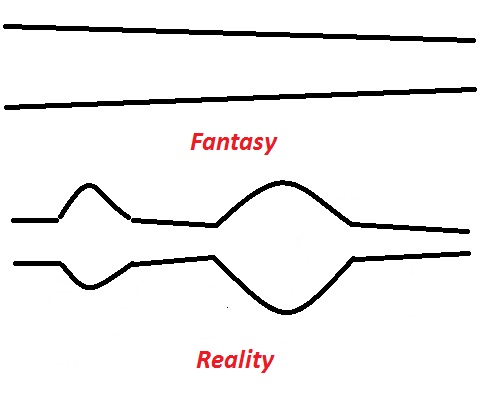
Take a look at the drawings above. In one, the path leads predictably and smoothly to an ever-closer connection. Note that is the other drawing the path leads to a closer connection but the path veers from closer to distant, then back to closer. This is the path of connection in marriage.

In this drawing, there is a re-connection after something leads to distancing in the relationship. The distance is followed by relationship repair. Closeness is not predicted by the beginning connection, but by the couple's ability to regain closeness after they have come apart. This is the main task of building a more intimate marriage.

How Do You Interpret Distance In Your Relationship

Distance creates tension which leads to fears and anxiety. It is easy to fall into the trap of labeling your partner as the problem rather than the relationship having the problem. Accept that your relationship is not a failure if you become distant. It is only a failure if you do not repair the relationship. 

It is important to interpret distance in your relationship as a call to addressing the issues that are creating the distance. Not only do you need to assess what is causing the distance, but you must make a mutual effort to repair the relationship bond. 


Why Couples Counseling Is A Bad Business Model


If you were going to open a gym and you only had exercise equipment for couples to use together, I predict that your business would fail and fail quickly. Why is this? The problem would be that it would only take one of the partners to keep them from coming to the gym. After the initial romantic notion of working together to reach your fitness goals wore off, one of you would begin to balk at going to the gym. Eventually, motivation would be lost and you would be back to being couch potatoes.

A marriage counseling practice is built under this same premise. Couples typically make a decision to enter couples counseling without much consideration for the commitment required. Instead they are simply taking a small step to have a better relationship (or put out a fire). When asked what they hope to achieve by coming for therapy, most couples are vague because they have not discussed this.

If you go to the gym without clear goals, you will soon find that the effort it takes to work out regularly has evaporated. Couples must work together to improve their relationship and it only takes one partner to undermine that effort. That's why it's so important to begin couple's therapy with a mutual commitment.

Anticipate that couples counseling will require effort expended over months, not days or weeks. Count on the work triggering anger, pain and tension before it leads to cooperation and an improved relationship. 

If you anticipate the potential stumbling blocks to remaining committed to the process, you will be much more prepared to summon the motivation to stay on track toward a better connection that will benefit you for years to come.